

How Hetton Academy helps students facing persistent disadvantage thrive
Removing barriers and going above and beyond to make sure every pupil succeeds.
At Hetton Academy in Sunderland, many children are up against significant challenges beyond the school gates. Principal Vicky Pinkney shares how the academy removes barriers to learning, helping pupils build confidence, fulfil their potential and achieve strong outcomes. From free breakfasts and emergency uniform provision to enrichment activities, academic support and trusted relationships, Hetton Academy is going above and beyond to support their pupils.
Vicky's story
Hetton Academy is a fairly small academy with 730 students, based in the North East of England on the border of Sunderland and Durham and most students come from a white working-class background. The school joined Northern Education Trust four years ago after being a ‘Requires Improvement’ school for a number of years. Over the last four years the academy has seen a significant improvement in outcomes.
The local community
In Sunderland, 21.3% of students face persistent disadvantage, meaning they have spent 80% or more of their time at school receiving free school meals.
Some of the local area has lacked investment for many years and there are some issues with anti-social behaviour and crimes associated with this.
Hetton Academy is in a proud ex-mining community with high levels of deprivation and unemployment in the local area. Almost 50% of the students at Hetton Academy receive free school meals and 49% are on Pupil Premium, which equates to almost half of each year group.
Changing the local perception of education
Many of our parents have had a poor experience at school and we have worked hard to make Hetton a successful learning environment and to raise academic aspirations.
This has been a challenge, but the tide is turning. We are becoming the school of choice in the local area as parents are beginning to appreciate that by passing GCSEs, pupils can go on to further education or employment options that might not be accessible otherwise.
Getting grade 4 or 5 at GCSE is the key for our students’ life chances, allowing them to get the college places they want, to go for an apprenticeship, or give them access to whatever career opportunities they want in the future.
We talk about this with the students and parents all the time, at every assembly and at every parents' evening. We try to instil that everyone needs to try their best to succeed. There will be some students who won’t achieve a grade 4, but as long as they are trying their hardest, they will make progress from their starting points and future employers and colleges will appreciate that.
Our English results are amazing: in 2026 91% of students achieved a grade 4 or above in an English qualification. Also, 80% of students gained a grade 4 or above in English and Maths compared to the national average of 64.8% and Sunderland average of 63.6%.
Support beyond the classroom
Every student can access a free breakfast every morning. Due to our high percentage of students that qualify for Pupil Premium we make this available for all, which gives them the best start in the morning.
Some students’ circumstances will make having the right uniform challenging. We have a uniform cupboard that has everything they might need. If students come to school without uniform, or are wearing trainers instead of shoes, we give them whatever they need to wear for the day. We buy uniforms to keep it stocked and we have a uniform ‘swap shop’ where we take in second-hand uniform that families can access and keep whenever they require.
They come in knowing that even though they're not equipped for school, they will be once they have walked in the door. We do what we can to support, and occasionally that does mean washing their clothes if there's an issue.
We know that if they need anything, the students are confident to come and ask.
We also offer a bridge provision which is in a quiet location upstairs and provides a unique place for support; for example, if a student has had a negative experience at home and they come in really upset, we can intervene to support them back into the classroom.
We always strive to get the students into lessons as that is usually the best place for them, but the bridge gives them time, a safe space and a member of staff who will listen. Some of the students eat breakfast there in the morning and then go to class because it's the only bit of calm they get before they go into lessons.
I don't think that the students are aware of being disadvantaged because they don't know any different. By ensuring they all have uniform, resources, free breakfast and lunch, nobody looks different or stands out.
A cultural shift
As an academy, we’ve worked hard in the last couple of years to build a culture of praise within the building. We've also significantly changed the way that we teach over the past year, being much more teacher led, but with choral response from the students in lessons to get them actively involved in learning.
As a leadership team we are never in an office. We sit in lessons to support learning, praise students for the things they are doing well and are on the corridors during changeovers. We are visible in the diner across all breaks and lunchtimes so we can speak to the students; we are lucky to work in a smaller school where the students know the leadership team and are comfortable and confident to engage with us.
We know all of the students, we know the families.
Extensive enrichment
We have an extensive enrichment programme for our students, including Doughnut Club, Homework Club, Drama Club, Rock Band and Cooking Club. At KS3 especially, it's really important that we offer this to develop communication and life skills; it gives them the opportunity to make new friends and try different activities which they might not be able to access at home, in a supervised and supportive environment.
A lot of students go to Craft Club. In the spring term, they made flowers out of paper as gifts. However, challenges at home made some pupils reluctant to give them to their own families. So, we organised for them to visit members in the local care home and give them the flowers; the students loved being able to speak to the older generation and seeing the joy that their crafting brought.
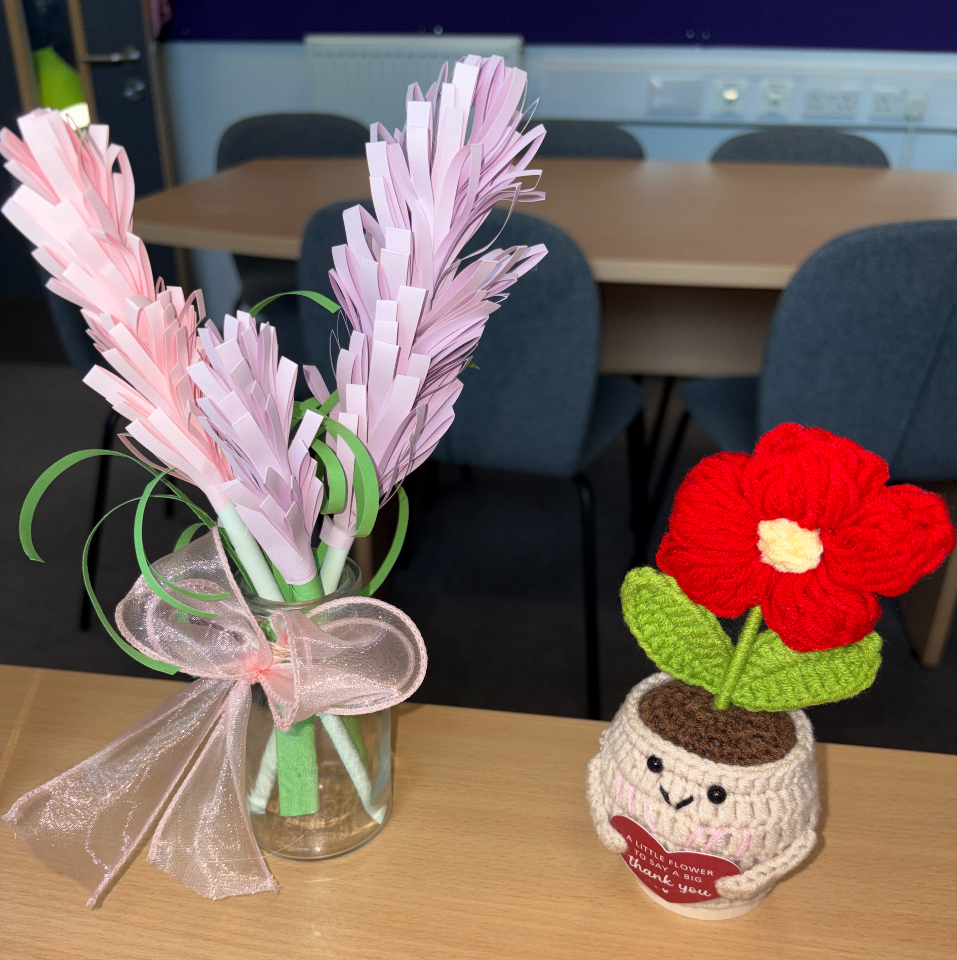
Students' paper and crocheted flowers created at Craft Club.
There is academic enrichment for the Year 10s and 11s every night across English, Maths, Science and Humanities subjects, allowing bespoke interventions to take place in a nurturing environment where their teachers can develop their subject understanding further.
Some of the students really engage with enrichment because it's a chance for them to be kids and have fun. Some of them are responsible for looking after little ones at home or are carers so this allows them to have some time for themselves.
Taking action
In our academy we host a RAG (Red, Amber, Green) meeting twice a week. Every student in Year 10 and Year 11 will be rated red, amber or green, depending on if they are on track to get a grade 4 or 5 in English, Maths, Science and Humanities. If a student is green, they are still on track to get grade 5s.
We really drill into those students who are not on track to get a grade 4 or 5 and figure out what we can do to support them and any additional intervention they may need.
We look at if they are facing disadvantage, whether there are issues at home, whether they have a place to study or if they need additional resources; we then plan and action the conversations that need to happen around this.
If there needs to be an action, it’s completed that night. If a phone call must happen, then it must happen after the meeting. If we change a timetable because a student needs to move class, that happens the next morning.
If there is an issue, then there is an action and it is very action driven.
We then revisit and look at the impact the next time we meet.
Making a difference
Due to knowing our students so well, we have made a real difference in the achievement and the attainment of our students over time.
During the summer term our Year 10s will sit assessments which take place in the main hall, in the seats they'll sit in next June for their GCSEs. After the assessments we have an assembly where they get their results in an envelope and that is the start of their journey to Year 11. This launch is a big moment for them!
By the time they come to sit their real GCSEs they will feel comfortable in their seat and know what happens at the start and during each exam; this ensures they feel calm about going in for their real GCSEs.
Equally, that feeling of opening your results and thinking, 'Maybe I didn't do as well as I could have’, or seeing how close you were to achieving your desired grade, really has an impact.
Being able to speak to your subject teacher and ask, ‘I'm disappointed with my grade – what do I need to do to improve?’ or ‘How far away am I from the next grade? Where did I go wrong?’ can lead to some powerful conversations. Due to the community that we're in, those conversations don't always happen at home. So, we ensure that support is there.
Practical support
At the start of Year 11, we have an evening in September called ‘Fish and Tips’. We make a big deal of it – students get an invite and they are encouraged to come with somebody from home to encourage the parents into school. The whole family can get free fish and chips afterwards. It's a great way to involve the parents in the launch of Year 11 and to include them in supporting their children through one of the most important years.
Every student receives a bag to take home with every revision guide they will need for the subjects they are studying, plus highlighters, a calculator and any resources they need for Year 11.
Even if they have not got Wi‑Fi or any books or resources in the house, they have been provided with resources to support them to complete homework or to study at home.
We also have the library staffed and open every night for students to do independent study, and the academic enrichments that we run allow for an hour extra study.
We try to mitigate everything – and that has been really successful.
Setting expectations
The students are very aware that we have high expectations and as a community both students and parents are recognising that the results and ethos of the school can lead to the students getting the post-16 provision they want. My window is full of cards from kids and parents who really appreciate what we’ve done to support them.
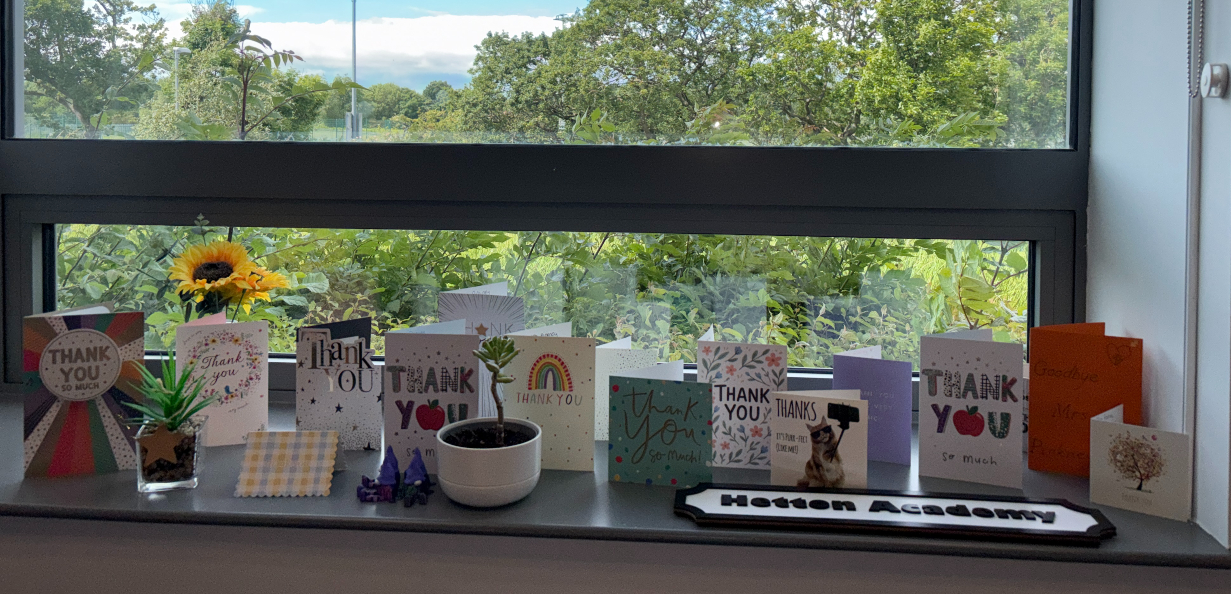
Thank-you cards from pupils and parents displayed in Vicky's office.
We have also got a speech and language provision; prior to the trust the students in the provision were not entered for GCSEs and they did not attend mainstream lessons. Now, they are fully integrated into the curriculum with support and are achieving academically. We support them to be successful and find the right college places to continue their journey.
Not everybody needs to be a high-flyer, but getting them to the right places to move on in the future is important to me.
Fulfilling pupil potential locally
As an academy we do a lot of work around careers. Our Year 7s recently went to Sheepfolds, which is a regenerated area in Sunderland, to learn about local career opportunities.
We also have our annual careers fair where we invite local employers. Nissan is a big employer in Sunderland and also Amazon just over the border in Durham. They come in regularly and that is really valuable as it gives the students aspirations and knowledge of what careers are in the local area.
Health and social care is another big employer in the area; because of this we adapted the curriculum offer a couple of years ago at Key Stage 4 to ensure we offered health and social care as a course to meet the needs of the local employment market.
The importance of caring
As a principal I care about every single child in my building and have high aspirations for them because some may not have support outside of school. If we do not care enough to make it right for them and give them every advantage and opportunity we possibly can, then perhaps they will not be as successful in life.
And that's the last thing you would want for any of your own children, isn't it? My staff really care and we all want the best for our students no matter their background.
Help us rewrite the future
Join our campaign to help children in long-term poverty have the best chance at a brighter future. Start by downloading our report to see our in-depth research and other stand out schools. Then please make a pledge below, to help support the pupils who need it most.
Together, let's rewrite the future for children facing persistent disadvantage.