
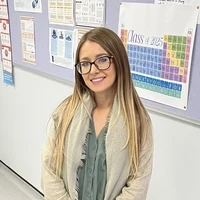
From science technician to teacher – passing on a passion
Watch first, then take over small bits of the class — confidence built gradually, in the community you already know.
Devon is a science teacher trainee at Robert Clack School in east London. She’s in her first term on the Teach First School-Centred Initial Teacher Training (SCITT) programme, delivered by training partner Barking Abbey School.
I worked as a science technician for four years at the school I’m currently training in. I was inspired by the teachers and their lessons. I wanted to be more involved in the lessons and in teaching the pupils, so I decided to train as a teacher.
From technician to trainee teacher
Going from a science technician to a teacher, I felt like I was quite well prepared in terms of the practical tasks and what to expect around science as a subject. I felt like there was a lot to learn about teaching the pupils. Getting to see the pupils engage in and carry out the practical tasks I used to prepare is really nice to see.
Choosing a route to teaching
I went down the SCITT route rather than university as I wanted to have more hands-on experience from the beginning. I decided that it would suit me to be in the actual school and thrown into it from the start. I chose to do the Teach First SCITT as I felt there was a lot of support available and it was a very gradual and structured way of training.
Train locally and you are more familiar with the community.
I also found that I could train at the school that I was working in. I am local – I grew up in this area – and there are lots of benefits to training locally – you're more familiar with the community that you're going to be teaching in, and you have a better understanding of the life that pupils might have outside of school. Then you can be more relatable to them as well.
A warm welcome
Being a trainee in the school community you feel welcome and like you're part of the teaching team straight away, and that you're involved in not just the teaching side, but in the meetings and the planning.
I'm now two months into the SCITT training programme. It's nice to have other trainees – including quite a few other science trainees – going through the same thing and to meet them all during the initial training, getting to know everybody. We have a group chat so we can all give each other advice, ask questions and get to know everyone’s experiences in their schools. We’ll have that connection throughout the rest of our training.
Varying intensities of training
It was so helpful to do those first two weeks of intensive training before we started in school. They were full on but you do learn a lot, and it makes you more prepared when you get into the school on the third week.
You can take it at your own pace.
I then found the training in school to be at quite a gradual pace, which I enjoy. You get to observe lessons first and then, when you're confident and comfortable, you can start taking over small bits of the class, which I found beneficial because the idea of being in front of a class was quite daunting to start with. To be able to watch teachers and then put some of your ideas in and see how that goes, it's been really good.
Experimenting with new ideas in class
What I like about training is that you can try out some ideas, see how pupils respond, and then adapt them. I’ve found pupils respond more positively to lessons through discussions and practical tasks. I hope pupils feel like they have a safe, positive space when they come to my lessons and that they enjoy them. I want to create a welcoming atmosphere for the pupils.
I'm still trying to find ways to adapt my lessons; some concepts are quite tricky to grasp. I’ve found referring to the curriculum helps you to keep on track. You can look at which part you're supposed to be on and what you need to teach.
Great support from all sides
There's a lot of wellbeing support for trainees, in terms of the mentors at school and through the SCITT programme itself. You can email any time you want, and they give you lots of advice.
The support from my mentor has been brilliant. He's given me lots of feedback, lots of ideas to take forward and given me a better understanding of my progression, so that's motivating.
A passion for passing on science
There’s a shortage of science teachers across the country and I think there are benefits to being a young science teacher. I feel like the pupils can relate to you more – maybe the people who are struggling or don't really find science interesting. Right now, I'm mainly teaching biology, but as time goes on, I’ll take on chemistry and physics lessons too. I'm really looking forward to seeing how that goes.
What I enjoy most about teaching science is seeing how excited the pupils are when they walk into lessons if we’re doing a topic they're really interested to learn about. And I love having discussions with them relating science to real life.
Inspired by Devon’s journey?
Train to teach and make a difference in your community through our SCITT programme.