

Building the Empathy Generation™: Ed’s journey from the classroom to global impact
Ed’s time in the classroom revealed a simple truth: empathy helps every student flourish. Since leaving teaching, he has built Empathy Week – a movement now reaching 2.5 million students worldwide. His story shows the power of a teacher’s vision to spark global change. Here, Ed tells his story in his own words.
I loved my time teaching in classrooms. It was those days, weeks and years that solidified in me that empathy was the underlying skill to master to create a learning environment that allowed students to flourish.
I left in 2017, and now I’m looking at a global movement that has reached over 2.5 million students in seven years and 700,000 students alone this year.
The journey from being a teacher to founding Empathy Week has been a whirlwind of storytelling, cinematic exploration, and a deep-seated belief that empathy is the most important skill we can teach the next generation.
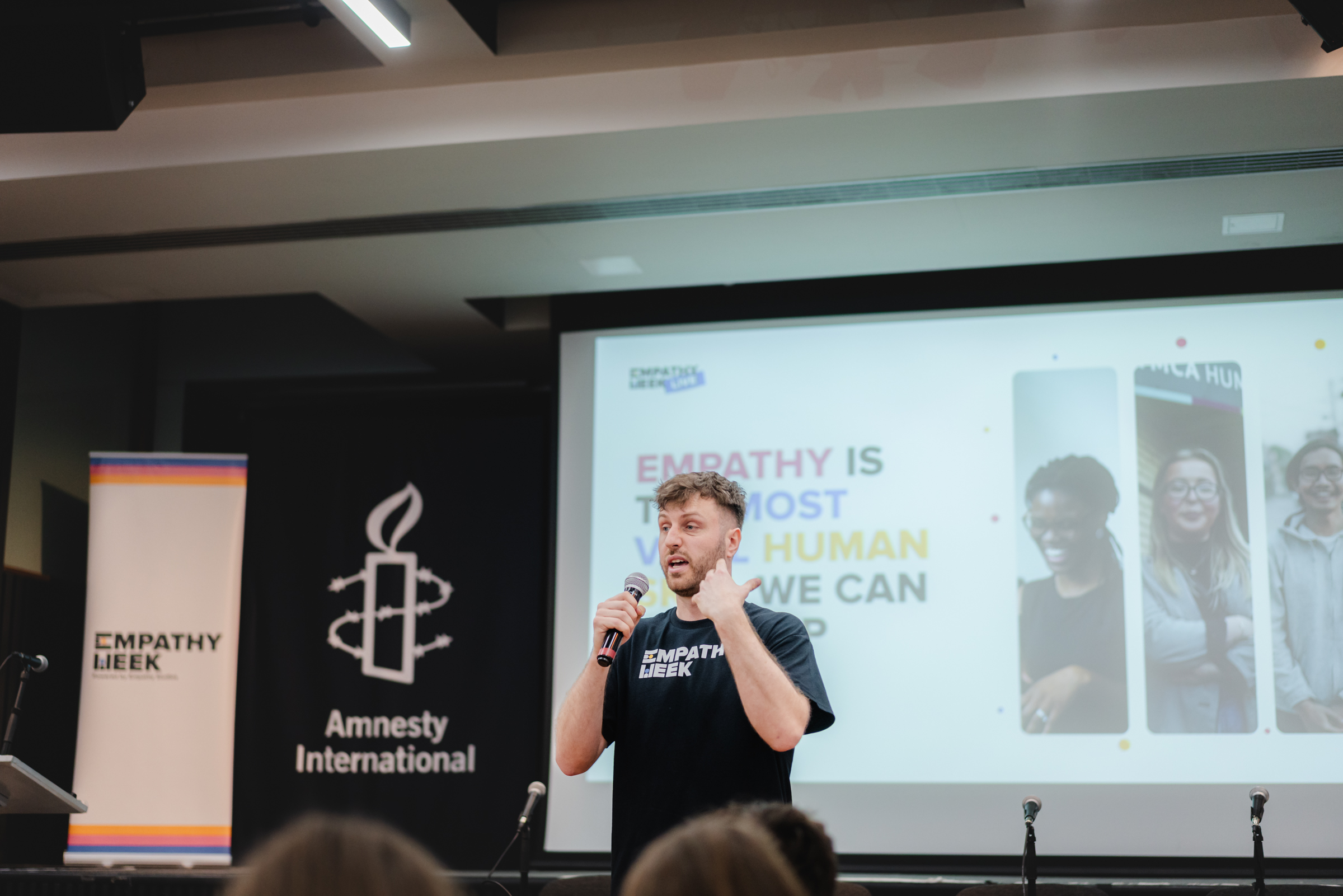
Ed speaking at an Empathy Week event, sharing how storytelling can help students build empathy.
What is Empathy Week?
The world’s largest empathy festival, it’s an annual event of film, storytelling and events that develops the crucial skill of empathy in students aged 5-18 across the globe.
Empathy Week began as a mini project when I was transitioning from my role as a teacher into a filmmaker.
I wanted to find a way to distribute stories that were powerful, not pitiful.
I wanted a way to distribute stories that weren't about feeling bad for other people (you know the charity adverts of the early 2000s I’m talking about), but were actually about understanding someone from a different background and being able to see your own life and perspective in a more powerful light.
We launched in February 2020 – which, looking back, was probably the most difficult time in history to launch anything. But despite the pandemic, we saw an incredible response from teachers globally who needed a way to connect their students and for them to be able to connect to others in the world.
I’ve seen students and teachers connect on a much deeper level because they are practicing understanding rather than judgment.
It opens up a dialogue that didn't exist before and helps build a genuine sense of belonging within the school gates, regardless of the neighbourhood or country the school is in.
When a school participates in Empathy Week, they aren't just checking a box; they are beginning to spark a cultural shift. The materials we provide from films, assemblies, and lesson resources to events all act as a catalyst for connection.
Why empathy?
Many of the things we talk about in education can be routinely diluted down to buzzwords – belonging, inclusion, culture to name a few. They often feel intangible, hard to measure and therefore spoken about but not often actually directly built. I realised that if you break all of these words and concepts down that they are all built on the foundation of one skill, empathy.
Crucially, empathy is a skill that can be trained.
We’ve worked with University of Cambridge to provide evidence around our framework and through our work at Empathy Studios (our umbrella organisation) have seen great success. We’ve seen this in schools like Kingsmead School, a Teach First school in London, where empathy is woven into day-to-day pastoral care, the PSHE curriculum and the wider school culture.
To develop empathy, you have to increase the diversity of experiences a person is exposed to. Since it’s hard to physically take students all over the world, I decided to use film to bring the world to them.
The Teach First influence
My experience with Teach First and in the classroom is the bedrock of everything I do now. It gave me a first-hand understanding of how schools work and, more importantly, how students think, feel and behave. It’s a huge part of our film-based approach to developing empathy. Here are nuggets that might be useful to you:
- Student connection: Students need to be loved. A word that is not used enough in education but to me means: accepted, seen, heard, understood and cared for. It’s only then that the feeling of belonging will come and that students can flourish.
- Behavioral insight: Respect is a word used a lot in schools. As a teacher you have to earn this from your students. The best way to do this is to showcase who you are as a person but be genuinely interested in who they are as people as well. Behaviour is communication. It doesn’t mean it’s right, but it is giving you information about a student and your job is to find out why that behaviour is being shown, build bridges and earn that respect.
- Students don’t need spoon-feeding: Too often in assemblies I’d see an issue be discussed or spoken about but it lacked the context of the whole human story. Anti-bullying would focus on the bullying act or reprisal and would regurgitate the usual language “be kind” that would make both my students and my own eyes roll. Students need to see context, they need to be given opportunities to think, discuss and speak. We need to build skills like empathy to prevent certain behaviour from happening.
If everyone is more connected, if we can build better relationships, then we will see improved behaviour school-wide.
My advice to future Change Makers
If you have a big idea to improve educational outcomes or help children facing disadvantage, my biggest piece of advice is to just start. Don’t get bogged down by the sheer number of things you need to do to reach your end goal.
- Focus on one thing: I focused on the skill of empathy. Find your one thing and do it well.
- Have a massive goal: Our goal is to build the "Empathy Generation" and impact 10 million lives by 2030.
- Iterate and evolve: Empathy Week has changed multiple times to survive and grow. Your first idea won't be your final one, and it shouldn't necessarily be, so don’t wait for the perfect way to start.
- Don’t expect instant support: Often, your biggest champions will be people you’ve never met before but love what you’re trying to do. Lean into them, grab a coffee, meet people and get cracking.
Don’t sit on your idea. Test it, build relationships and go for it.
Worst case, it doesn’t work but you've learnt some crucial lessons. Best case, you impact more lives than you can ever imagine.
Ready to create change in your classroom and beyond?
Train to teach with Teach First and start your journey to transforming pupils’ lives.