
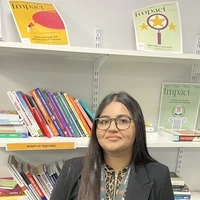
Making maths fun – Momina’s SCITT journey
Creative teaching can turn problem solving into possibility, helping pupils see where education can take them.
From playing teacher as a child to playing problem-solving games with her pupils as a real-life maths teacher. Momina is using her skills and experience to show pupils where their education can take them.
As an early career teacher at Barking Abbey School, Essex, Momina shares her journey on Teach First’s School-Centred Initial Teacher Training programme (SCITT).
Momina's story
Since I was a child, I have always been inspired by teachers. I had a whiteboard at home, and I used to act like a teacher, learning by teaching things to myself. That’s what led to my passion for teaching.
My degree was in game design and animation, but I knew I wanted to become a teacher. So, I spent a year teaching game design and animation in a college before applying for the Teach First SCITT programme.
Making a difference locally
The main reason I chose SCITT rather than the university route was because it was local, so I could apply to schools near me.
Training locally was good because I was aware of the students, their needs, and how to tackle them. I used to live here, so I know the area well.
You also spend more time in the classroom with SCITT. I preferred being more school-based because the practical and theoretical skills go hand in hand.
Being in a school full time, you learn on the go.
When I started the programme, I was going around different classrooms, meeting the students and the teachers. I was learning all the different skills because I was there full time.
Turning theory into practice
The intensive training felt like information overload at times, but it was delivered really well.
Every day was structured. We’d have sessions, observations and opportunities to do deliberate practice. And I’d get together with the other SCITT trainees each week to do the training work.
The curriculum was good because it linked the theoretical with classroom practice. It was useful to go through the topics and then practise them in a real-life situation.
I especially liked the conferences and seminars that formed part of our training. I would learn how to teach a concept and take that into my classroom practice.
My broader school experience placement was at Eastbrook School. It was great seeing how they dealt with different situations. I used to struggle with behaviour management, but when I went to Eastbrook, I learned how to use behaviour management techniques.
Feeling supported at every step
The support from my mentor and school was brilliant. They were always helping and checking in on me.
Communication was very open. Especially with my mentor. I could go up to him any time of the day and ask for help. He was really supportive.
It’s because of him that I survived the whole year juggling university learning and teaching. He would always check on me, and he cared about my wellbeing.
Going from trainee to teacher
While I was training, I thought I would apply for a job at the school because I really enjoyed it there. A job came up; I applied straight away and got offered it.
Starting out in my training school has meant the transition to being a qualified full-time teacher was really smooth.
I didn't have to learn about what they do or their values because I’d already been here for a whole year. So, I knew what to expect and what to do.
The opportunities are endless
I want to inspire my pupils and show them that education opens doors – like it did for me.
I did A-levels in biophysics and chemistry because I wanted to become a pharmacist. Then I changed to game design and animation, and finally another change into teaching.
So, I tell them that education can lead into many different careers because now I have all these skills.
Making it click
The important thing in teaching is to look for that light bulb moment with your pupils. It’s exciting when at first they can't get a concept but then they get it. It tells me I'm teaching well.
One of the key takeaways that I've used from my SCITT training is using visual models.
While I was training, I remember teaching a Year 7 pupil negative numbers. He couldn't understand until I showed him visually using counters. The look on his face told me that he'd understood.
Pupils always come to me for help. I think that is the main reason I stayed in teaching – I always wanted to help others.
Turning problems into games
I also want to show my pupils that maths is about problem solving, and it can be fun.
My background is games design. So now, I try to bring games and challenges into the classroom. My plan is to make a game about negative numbers to help my Year 7s understand the concept.
Maths needs problem solving. And when you're gaming, you have to problem solve and have a keen eye for detail.
When you have those skills in the classroom, you know which pupil is struggling with what. It's like when you're coding, you know where you wrote that line of code that's wrong. And you can take that same skill back into the classroom.
You don’t have to go far to change lives. Discover how our SCITT programme can help you, like Momina, open doors for young people in your community.