
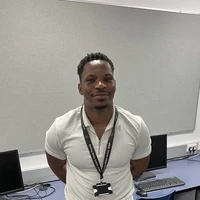
Never giving up – Gabriel’s SCITT journey
Teaching locally is a chance to give back and make a difference in your community.
Gabriel is an English teacher in Dagenham. Inspired by teachers who supported him when he first arrived in the UK, he joined Teach First’s School-Centred Initial Teacher Training (SCITT) programme to make a difference in his local community.
Giving back to the next generation
I came to this country when I was seven. I couldn't really speak much English.
Having strong English teachers who knew the subject allowed me to catch up to my peers much quicker. They were responsible and wanted to help me.
They didn’t put me at the back of the class because of my ability. It inspired me to get into teaching.
I was very dedicated to learning the language. I worked hard and I enjoyed it because it was a confidence boost, having the ability to communicate my feelings and ideas at a high level.
It’s a good skill and it’s something I want to give back to the next generation as well.
I have this part to my personality that wants to give back. Rather than thinking about myself, I’m thinking about what I can offer society.
When I was in Year 11, one of my drama teachers said, “You know, I see you as a teacher”. Initially, I laughed at the suggestion and didn’t believe it. But I never forgot.
Influencing the area where you live
I’ve spoken to many teachers about the different teacher training routes and I did my own research.
I wanted to join the SCITT programme because you get to learn as you go and you get support.
With Teach First you go straight into teaching and that trial and error slowly allows you to understand what impactful teaching means, and to improve the quality of your own teaching.
The more you teach, the more you improve. So that’s why I went for SCITT.
I also wanted to work in a school that wasn’t too far away from me, so I could influence the area I was working and living in.
I grew up in Newham, not too far from Dagenham.
Training locally helps you understand the pupils.
You understand each other’s point of view and it helps you settle into school quicker. It creates empathy. For example, when a pupil gets things wrong, it’s easier to understand and be able to offer help. You’ve been through what they’re going through.
Knowing that you’re in your placement school for a considerable amount of time allows you to build good relationships with your pupils. And they get to trust you because you’re there to help them.
Getting support on the programme
SCITT has many wonderful features. I have a fantastic mentor, Vicky, who helps me and is as dedicated to me as I am dedicated to my subject. It’s helpful having someone who is a shoulder to cry on, metaphorically speaking.
At first, I was apprehensive. But the school is of a very high quality and I’ve received the support I needed. I feel like I made the right choice.
Having support in place outside of the classroom helps you to feel confident inside the classroom as well.
Even when it’s difficult, you have people come in and tell you, “Don’t stress, this is how to do it”. That support is very helpful, especially for your mental wellbeing.
Making mistakes and learning from them
Every day at school you learn something new.
Every day you make mistakes, but you learn from them.
My first lesson with a Year 8 class was quite difficult, but the next lesson you get an opportunity to amend your errors and learn.
Putting learning into practice
I found the intensive training very good. There were teachers leading the training who have been doing the job for a long time, so it seemed second nature to them, and they had good knowledge to share.
The information was manageable and I could use it in my work. It wasn’t information where you tested it and it didn’t work – it actually worked. I can implement it into my practice.
It was difficult at times, but the quality was good. The difficult segments were broken down into simpler ways of doing things.
Even as teachers, we need things broken down for us, to then break it down even more for the pupils.
Working with other trainees
You learn a lot from other trainees and pick little things up along the way.
For example, you might learn a style that you might not have used or thought of before.
Everyone has a different way of teaching. My way might be different to others, but it’s good to learn from everyone.
There are different cultures and it’s beneficial having people from different backgrounds and walks of life to get feedback and to share the good and the bad.
We have many SCITT trainees in the school. Some of us had the opportunity to co-facilitate a Black History Month lesson. We sat down together and worked out who would teach each section, helping each other. It was a good way to learn how to share resources. It’s something I’ll be doing a lot in my teaching career.
Gaining classroom experience before SCITT
Having teaching experience before SCITT was helpful. I’ve worked as a class cover, in special educational needs, and in many aspects of teaching which help me to make my classroom inclusive.
For example, when focusing on pupil behaviour, I can tap into my experiences with similar pupils in a different setting, which helps me to respond in a way that works.
Getting that experience beforehand will really help you.
Never giving up
I hope to be a teacher who is known to take the job seriously, but is also fun and interactive, able to set clear boundaries and allows pupils to express themselves. A teacher with integrity, who appreciates the little things and creates an inclusive classroom environment. So that no matter who walks into my classroom, they will benefit.
What I love most about teaching is that light bulb moment – when a pupil finally understands.
When a lesson has been broken down into segments and it gets difficult, but you keep persevering.
And because you keep persevering, the pupil does too. Then eventually we get that light bulb moment when they understand – there's joy on the teacher’s face and on the pupil’s face as well.
I don’t give up. If a pupil asks a question, I’ll have follow-up questions. I want to know that they fully understand. Sometimes a pupil might think I’m working them too hard. But it’s about the quality of the teaching I want to give, knowing that every pupil who walks in will be challenged. And hopefully some good will come from that.
Finding your identity
If anyone is thinking about starting SCITT training, I would say that you’ll have dedicated support. You’ll be introduced to new concepts and ways of teaching. It will be scary at first.
But the more you do it, the more you make mistakes – the more you learn, adapt and find your identity.
And enjoy the process. It’s a demanding one, but it’s beneficial to you and the pupils you’ll be teaching.
Imagine having a job you love
Make it happen with our SCITT programme. Join others like Gabe who have found purpose changing lives through teaching.