
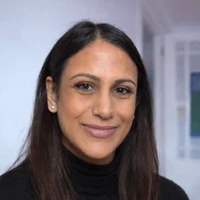
From Performance Analyst to Director of Learning – Sivani's journey
Swapping a career in finance for changing lives in the classroom, Sivani reflects on her experience training with Teach First, using her data and analytical skills to transform outcomes for her pupils. Ten years later, and now a Director of Learning in Staffordshire, she’s focusing on creating a school environment where pupils and teachers can thrive.
Sivani tells us her story.
Since school, I've always wanted to be a teacher. But it felt like teaching wasn't as highly regarded in my community as medicine or accounting for example. So, I didn't know what to do in terms of fitting those expectations.
I did a maths degree and went into banking for a while, but teaching was something I'd always wanted to do. While working in banking, I tutored and I loved it.
At the time I thought “This is giving me a bit of an insight into what teaching is.” It was only when I went into a classroom, that I realised tutoring and teaching in a classroom are totally different things.
Taking the leap into teaching
As I became more senior in the banking industry, I struggled to balance tutoring alongside my day job. I had to make a choice.
I was in my early 30s at that point. I thought “It’s now or never.” So, I started looking at how I could make the transition into teaching and what training route I wanted to take. And it had to be Teach First. That was a really big thing for me.
Teach First’s message just resonated. It's about closing that education gap.
A child's postcode shouldn't impact the education that they receive.
Learning on the go
A university friend was in the 2007 Training Programme cohort. He spoke so highly about it and it really helped talking with somebody who'd gone through the process. Another close friend of mine also trained through Teach First and spoke highly of it. So, I applied. I went through a rigorous process to be accepted onto the programme and then I began my training.
With Teach First, every lesson was about reflecting, which was really important. I liked the fact that I wasn't sitting in a classroom. You had that intensive six-week programme and then you were thrown in there.
It was tough. Especially in that first year, your learning curve is so steep. But that Teach First message reminds you why you’re doing it.
Fortunately, there was so much support available. Which was great because I'd made such a huge career change and I didn't want to fail. The support was there if you needed it. And I really utilised that. I had an amazing school mentor too, who is now a close friend who I still contact for help.
Now, I’m doing more to support and mentor other teachers. I currently mentor an IT teacher who's in my team and I've done a lot of mentoring over the years within maths, but I want to get a bit more involved.
Using data to drive change
I was a performance analyst for years – analysing data and making recommendations based on it. I do the same thing now. When you start as a classroom teacher, you're looking at how pupils are doing within the class. You're analysing, you're making changes, you're adapting your teaching.
In my second year of training, I was made maths data lead at my school. I looked at all the data across the maths department to come up with interventions.
Then, at my next school, I was looking into whole school achievement, where it's even more important that you're getting a well-rounded picture.
That's how I ended up becoming an assistant principal – by using data to raise standards. But by that point, I'd realised it's not just about looking at numbers. It's about looking at the pupil as a whole - what they’re like, how they work, and so forth.
My analytical background definitely helped me get to where I am.
Bringing my skills into the classroom
We talk about high standards all the time in teaching, but you've also got that in industry. Having those high standards, high accountability, and being able to plan more has all definitely helped me in teaching.
We're constantly met with tight deadlines in industry. It's the same thing in education. You've got GCSEs, you've got assessment points. And it's realising what to prioritise. I’m used to working under pressure.
Working in industry also means speaking to lots of different stakeholders, developing good communication skills. And how you deliver is totally different depending on your audience. I experienced that when I was a senior leader.
Sometimes I’m in front of a year group. Other times I'm in front of the senior leadership team or middle leaders. And every time, the same information is going to be presented differently. My time in banking really lent itself well to that.
Setting high expectations
My second school, Ark Globe Academy, shaped me. The head teacher had high expectations, and he made that so clear – to staff, to students, to everybody. Students were expected to graduate with the qualifications, skills and confidence to achieve their ambitions and go on to higher education or their chosen career.
One thing that has been ingrained from my Teach First training is that if we don't believe it, the pupils aren’t going to believe it.
Championing work-life balance
I’m now married with children. And I love my job. As a Director of Learning, I look after maths, economics, business, and IT. I work four days a week, which my school are very supportive about.
In our school, we get one wellbeing day a year, and health and family come first. Because happier, healthier teachers are going to work harder for you. It's a very supportive and inclusive environment and it gets the best out of teachers.
If you send an e-mail to a member of staff after 4pm, it will come up with an out of office notification. It's a little thing that makes a big difference.
Discovering a truly rewarding career
If someone is considering changing careers, I’d say teaching is a lot of hard work but it's the most rewarding thing I've ever done.
It's a different type of stress. Working in the city, you've got pension funds and what not. It doesn't have that same impact as thinking you could be the difference between somebody passing or failing a maths GCSE or getting those top grades. Because if they pass their GCSE in maths, it opens more doors to their future and what they can do.
I've chosen to work in schools where the percentage of pupils on pupil premium was quite high. I want to ensure pupils’ postcodes don’t impact what they're able to do. That doors won’t be closed based on where they live and that they can do whatever they want.
I had a pupil in my placement school who was in the foundation set for maths. He was on track to get a grade 1 and he struggled. But he said, “Miss, I'm going to get a grade 4.” He'd come to me every lunch. And he said, “I'm going to get it. Keep teaching me.” He had that mindset that we were instilling in him. And do you know what? Come August, he got a grade four. I was so proud of him. I’ll always remember that. And that's what it's about.
Could you take the leap and bring your skills to the classroom?
Join thousands of other Change Makers like Sivani and rewrite the future for the pupils who need it most.
Explore teacher training programmes
Are you an ambassador with a great Change Maker story to tell?
Please fill out this form and we’ll be in touch.