
Leading with purpose – how Tim transformed Highbury Fields School
Real school transformation isn’t about quick fixes – it’s about listening, building a shared vision and taking it one step at a time.
Tim is a 2004 Training Programme ambassador and a Headteacher at Highbury Fields School in London. Here, he shares his leadership journey with us – culminating in the transformation he’s led at Highbury Fields – including rethinking the curriculum, changing behaviour, and boosting attendance and outcomes.
Joining Teach First was very much about the mission for me. My mum was prevented from going to secondary school and as this was unnoticed by the school or any form of social care, she consequently didn’t gain any qualifications. She wanted to be a teacher but with that limitation she could never achieve her ambition.
Seeing that firsthand really aligned me with the mission to ensure disadvantage is not a barrier to children’s future chances.
My first role was in Clapton Girls Technology College as an English teacher. My mentor, Maggie, was inspirational and her passion for the children was powerful. She helped me see teaching as a long-term mission. I was keen to make a difference, but my mentor showed me that to make a real, long-term difference, children need continuity, stability and consistency.
The autonomy I was given and practises I was able to develop in this time really set up the leadership approaches that I use today. The mentoring from Maggie, the systems and innovative school leadership were all powerful in informing how I wanted to lead.
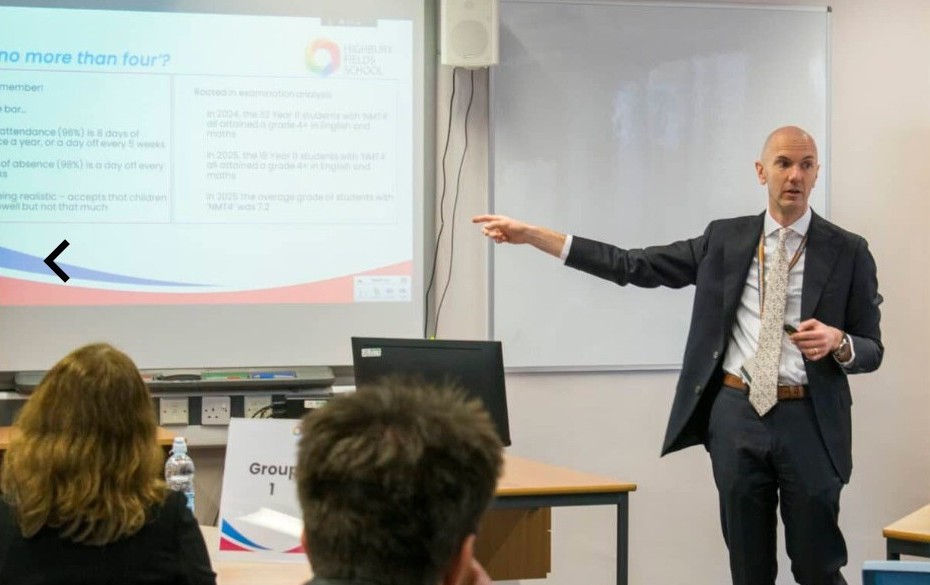
Tim Fox, Headteacher at Highbury Fields School and 2004 Training Programme ambassador.
Gaining experience and building leadership skills
Leaders need to have a broad range of experiences so I’ve consciously made decisions in my career to move to schools where I can learn more and expand my knowledge. I moved to a very large, mixed school in Greenwich to be Head of English and later a deputy head of school. In this role I was able to set up systems and structures to particularly help disadvantaged white-British pupils.
But I the education of girls and young women is important to me. I knew I wanted to return to a girls school. Highbury Fields, my current school, really sang to me. When I joined in 2010/11 it was an underperforming school. 53% of children are eligible for free school meals and when I joined, only 36% of children got a good grade in English and Maths.
Initially I joined as Assistant Headteacher and Head of English. Because of my experience in the Head of English role, I was quickly able to put mechanisms in place to improve standards in the English department. I was able to implement a curriculum that children want to study, schemes of learning to enable that, and to support colleagues to deliver it. Colleagues started to see the impact, recognised the practises were working and started to see what could be possible for the students in the school.
Moving into headship
I had to really think about the role of Headteacher when it became available. I spoke to people in the school and to senior colleagues to test how they would feel and how the community would react to a male head of a girl’s school. Fortunately, from those conversations, I got the sense the community was supportive, but my leadership team are all female and it’s something I still talk to them honestly about.
I became Headteacher in 2019, we had good results in English and Maths, and the school had been outstanding since 2016. However, under the surface, aspects of the school had declined. We had a 14% suspension rate which at the time was higher than the national average, attendance was only at 91.5% and this was all before Covid hit. We also had a high staff turnover, and children often left because we weren’t giving them a rounded, enjoyable experience.
So, I started by listening. I heard how children were feeling, the parent and staff community too. I was candid with everyone. The first step was creating a vision, collectively, for the school.
Our mission and purpose is to be a community in which everyone enjoys academic and social success.
I think as educators we can sometimes miss the fact that school should be enjoyable. If children enjoy their school experience; feel supported by friends and teachers, then the chances are that they will want to work hard and will be successful. We’re not afraid to say we want school to be fun.
Seeing opportunities during the Covid outbreak
One of my favourite expressions is we’re going to ‘raze it to the ground.’ I try to find opportunities within challenges and so when Covid hit, I tried to see it as an opportunity. During Covid we razed every single practice in the school to the ground and have been on a journey of rebuilding to best support our students. We knew we weren’t meeting the needs of all children and certainly coming out of Covid we were not going to meet these needs with what we were doing.
In 2020-21 we rebuilt our curriculum, building it around three key pillars. We lead with our pastoral curriculum, then we have a studied and an enrichment curriculum. Our pastoral curriculum is the idea of community, teaching children to look after themselves and one another. The studied curriculum is the way we sequence learning over lessons, over years to build that academic success. The enrichment curriculum is the social success and opportunities we provide for children to ensure they’re developing friendships and confidence.
Rethinking behaviour and improving attendance
We’ve also consciously changed how we talk about behaviour in the school. We have a ‘commitment to learning in the community policy’ and we teach the ‘reach’ characteristics of: Responsibility, Effort, Ambition, Contributions and Honesty.
We don’t talk about behaviour; we talk about the choices pupils are making and the positive impact those choices can have on them and others.
They have the agency to make better decisions.
Another key element is attendance and our journey in this regard is something I’m hugely proud of. If I look back to 2019, we had 100 days of suspension, we’re on 10 this year. In 2019 we had 91.5% attendance and it’s at 95% currently.
I’m so proud of everyone’s commitment, because it’s not me, it’s everyone knowing and playing their role – parents, children and staff sharing the same vision.
One piece of advice I’d share having been on this journey is not to rush things. It can be tempting in leadership to want to change straight away, but where you can, take time, look and listen. Take it one step at a time, work out the priorities and make sure what you are doing is working and sustainable before you move to the next thing.
Are you an ambassador with a great Change Maker story to tell?
Please fill out this form and we’ll be in touch.